What happens when you bring together mountaineers, documentary filmmakers, and scientists?
Ideas emerge that eventually turn into expeditions and, later, a documentary. That’s exactly what happened with The Fall of the Glaciers, a film that takes us deep into the glaciers of Torres del Paine National Park. Amid ice that creaks, breathes, and drips, a powerful story took shape, carrying a message that invites us to reflect.
We spoke with the documentary’s creators: Víctor Zavala, David Cossio, and Daniela Carrión.
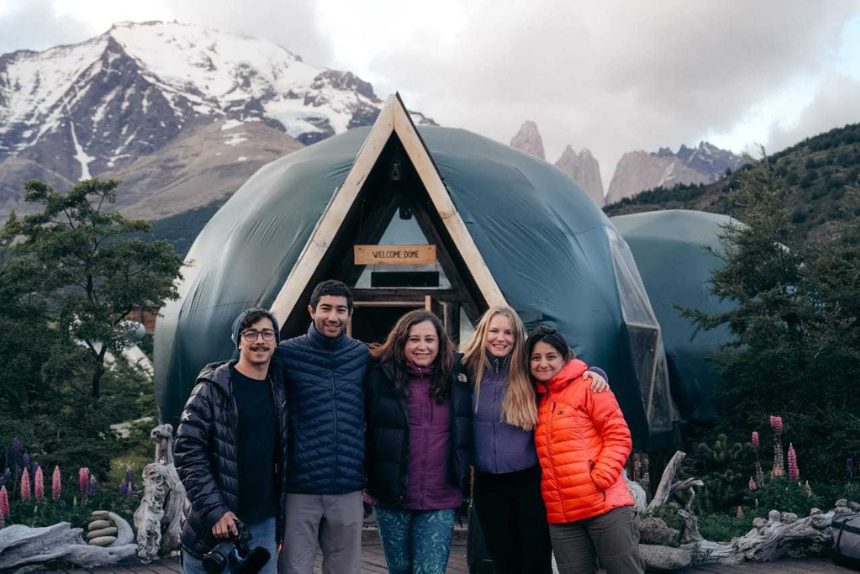
From left to right: David Cossio, Víctor Zavala, Daniela Carrión, Fabienne Meier, and Sindy Villalobos
Let’s start at the beginning: How did you first become interested in glaciers?
David: “I’m a photographer and filmmaker. I document expeditions, mountains, and travel, and I also make documentaries. I’m passionate about diving, climbing, and caving, too. I’ve been living in Chile for about ten years, but I grew up in Colombia, where my family always took me into the mountains. That’s where my interest in these landscapes began, eventually leading me to take part in expeditions.
It was Felipe, a glaciologist and friend of ours, who told us, ‘You should make a documentary about the glaciers of Torres del Paine from the perspective of the Paine Grande Glacier.’ It’s the glacier that has best withstood climate change and could tell the story of its ‘younger siblings’ that are disappearing. The idea was inspired by the Icelandic documentary Not Okay. That’s how the project began. It gradually grew to incorporate the perspectives of different people connected to ice, including Daniela, Víctor, and Seba, a mountaineer who also took part in the expedition.”
Daniela and Víctor, what is your connection to glaciers?
Daniela: “I’m a geographer from the University of Chile, and I’ve spent more than twenty years studying glaciers in Chile and Antarctica. But my story with glaciers began before I became a scientist. I started out as a mountaineer. I loved climbing mountains, exploring the Andes, and reaching those places where you feel more vulnerable.
At some point, those two paths crossed. A professor, Jorge ‘Pelao’ Quinteros, invited me to join an expedition to the North Juncal Glacier, where a group of Swiss scientists was conducting research and needed field support. I arrived as a mountaineer, but I came back from that expedition completely fascinated by glaciers.
Because walking on a glacier is one thing, but beginning to understand it is something entirely different: discovering that it moves, responds to the climate, holds information about the past, and is constantly changing. I started looking at glaciers differently and wanted to learn more and more about them.
I’ve never really stepped away from them since. I’ve spent much of my life studying them, exploring them, and watching them change. And I think those two perspectives still coexist in me today: the scientist who wants to understand what is happening, and the mountaineer who continues to feel deeply fascinated and privileged every time she stands in front of a glacier.”
Víctor: “My story is different. I’m a computer engineer and work as a digital analyst at Cascada Expediciones and EcoCamp Patagonia. About eight years ago, I started mountaineering and rock climbing.
Over time, I became interested in ice climbing, but before you can get into that, you need to gain experience in the mountains, on snow, and on rock. And along the way, you inevitably encounter glaciers.
For many years, glaciers were simply a means to an end for me: a way to reach a summit. Then I started seeing how much they could change in just a few years. Routes that once existed disappeared because the glacier had vanished or broken apart. That’s when you start asking yourself why it’s happening and discover just how important glaciers really are.”
.webp?width=860&height=645&name=Victor_1%20(8).webp)
Víctor Zavala on one of his expeditions, climbing Paine Grande
Speaking of the importance of glaciers, the documentary says, “They can exist without us, but we cannot exist without them.” What do you mean?
David: “The glaciers of Torres del Paine are part of the Southern Patagonian Ice Field, the planet’s third-largest reserve of freshwater after Antarctica and Greenland. That water is essential to ecosystems. Glaciers also hold an enormous amount of information about the planet’s history and its water systems.”
Daniela: “The vast majority of glaciers are retreating and losing mass. Over recent decades, the terminus of Grey Glacier has undergone significant changes. One of the best-known events occurred in 2017, when a huge iceberg broke off, covering an area roughly equivalent to twenty soccer fields. Ice calving is part of the natural dynamics of glaciers that terminate in lakes. However, in the context of sustained mass loss and retreat, these events contribute to rapid changes in their shape and the surrounding landscape.
One particularly interesting case that helps us understand this transformation is Echaurren Norte Glacier in central Chile. It has been monitored since 1975, making it one of the glaciers with the longest records of mass-balance measurements in South America. Today, it’s a very small glacier that is clearly losing mass. It’s no longer just a matter of its terminus retreating or the ice becoming thinner: the glacier has also fragmented, and parts of its surface are beginning to become covered with debris.
What we observe at Echaurren Norte helps us understand processes that can also be seen in other parts of the Andes and Patagonia. As glaciers lose mass, they can fragment into increasingly small, isolated ice bodies, while their surfaces become more extensively covered with rock and sediment. In fact, during filming, we found a very clear example of this at Olguín Glacier, where we observed areas of ice covered in debris.
I find it particularly interesting to show this because it challenges the image we usually have of a glacier as a vast, clean, white expanse. A glacier can also be partially covered by rocks and sediment and still contain ice underneath. Learning to recognize these forms is another way to understand how our glaciers are changing and how the mountain landscape is changing along with them.”
“Any tourism activity should do everything possible to protect glaciers and their surroundings, because these are precisely the landscapes that inspire people to visit these places."
- Víctor
Many people think a glacier is simply an enormous mass of ice, but as you’ve just explained, the documentary shows that glaciers are much more diverse than we tend to imagine
Daniela: “They’re much more diverse. When we think of a glacier, we often picture an enormous mass of white, almost motionless ice. But glaciers are dynamic systems: they flow, deform, gain and lose mass, and respond in different ways to climatic conditions and the characteristics of the terrain where they’re found.
There are different types of glaciers, which we can classify according to their size, geometry, location, or dynamics. For example, there are outlet glaciers, which drain ice from large ice fields into lower-elevation areas. Grey Glacier, which appears in the documentary, is an excellent example. It flows from the Southern Patagonian Ice Field and terminates in Grey Lake. Because its terminus comes into contact with water, some of its mass loss occurs through the breaking off of blocks of ice, a process known as calving. This creates the icebergs we later see floating in the lake.
There are also mountain glaciers, which are generally confined by the surrounding topography and associated with high-mountain basins or slopes. Their shapes, dimensions, and dynamics can differ considerably from those of large outlet glaciers. Their evolution is strongly influenced by factors such as elevation, aspect, slope, snow accumulation, and solar radiation.
And then there are glacierets, much smaller bodies of ice that move less and are particularly sensitive to climatic variations."
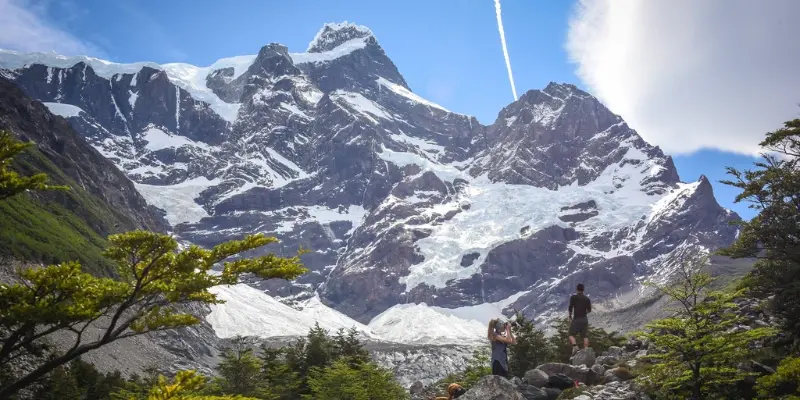
Víctor: “In the documentary, we show Grey Glacier, which is the best known; the glacier behind the Base Torres viewpoint, which is smaller and disappearing more quickly; and Olguín Glacier, which is much less explored and has different dynamics.
They’re very different glaciers, even visually, yet they’re all located quite close to one another. That diversity is precisely what we wanted to convey.”
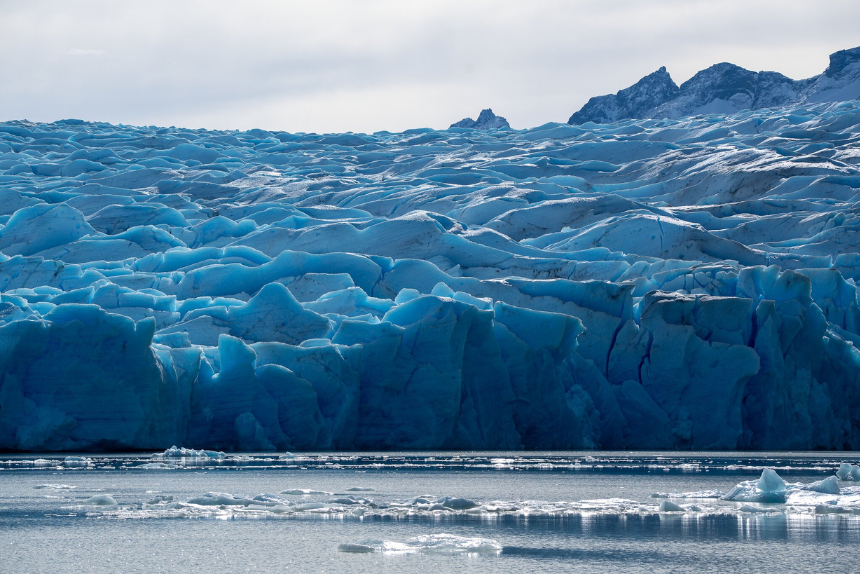
Grey Glacier
In the documentary, you talk about how it’s not enough to observe glaciers; we also need to listen to them. Can you tell us more?
David: “Every day, thousands of tourists hike to Base Torres. They look up and see what they think is snow, when in fact it’s a glacier. We show the vastness of these landscapes, but also what lies within them: the crevasses, the sediment. Above all, we show that glaciers breathe, fracture, melt, and make sounds. They have something to say. I don’t want to give too much away, because the best way to understand it is to watch the film.”
Tourism also features in the documentary. What message do you want to convey about it?
Víctor: “The relationship between glaciers and tourism is complex. On the one hand, glaciers are a major attraction and draw visitors. This allows more people to discover them and understand why protecting them matters.
On the other hand, poorly managed tourism can become intrusive and harm the landscape. It all depends on how it’s managed.
Ultimately, any tourism activity should do everything possible to protect glaciers and their surroundings, because these are precisely the landscapes that inspire people to visit. It’s about finding a balance and ensuring appropriate regulations are in place."
David: “People can develop an emotional connection with these landscapes. That makes them value them more and want to protect them. When someone has a personal experience in these places, they gain a better understanding of what glaciers are and why they matter. As the saying goes, you can’t protect what you don’t love or know."
What’s interesting is that people often arrive at a viewpoint, take a picture, and move on. But what they’re looking at is truly extraordinary. It’s a beautiful landscape, yes, but it’s also a landscape that is changing right before their eyes. You can see how far a glacier has retreated over the years and how it continues to retreat before your eyes.
Today, these changes can be observed within a human lifetime, as Víctor mentioned earlier, rather than only on a geological timescale.”
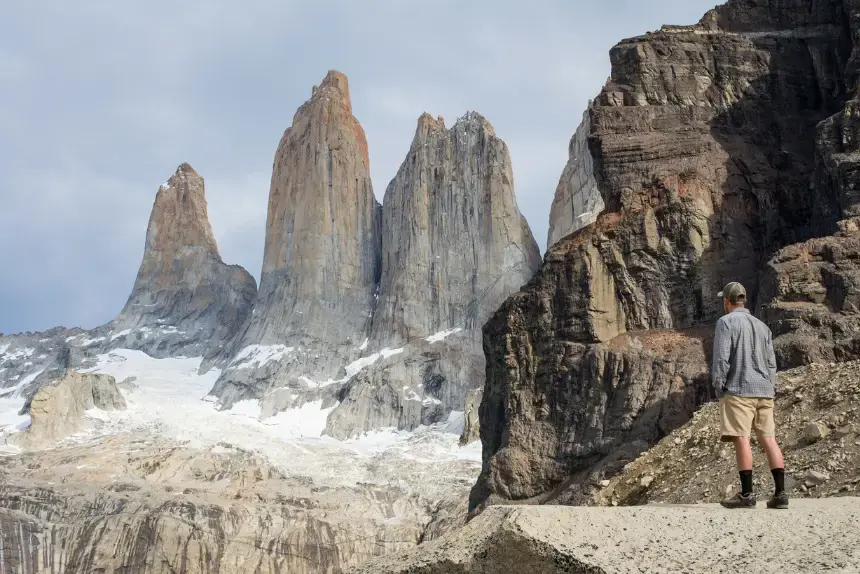
The Towers' Base viewpoint
Are there measures that can help slow glacier retreat or reduce the impact of climate change on glaciers?
Daniela: “We need to distinguish between local measures and the underlying problem. In some parts of the Alps, for example, geotextile covers have been used to cover small areas of ice during summer and temporarily reduce melting. However, these are very limited interventions that are expensive and difficult to implement across an entire glacier. In a country like Chile, with thousands of glaciers distributed along the Andes, many of them extensive, remote, and difficult to access, physically covering them is not a viable solution.
The most important measure for reducing glacier mass loss remains addressing the root cause: limiting global warming by reducing greenhouse gas emissions. At the local level, however, we can reduce other pressures on these ecosystems and improve their protection, monitoring, and our understanding of them.
One of the pressures we need to understand better is tourism. More and more people are visiting glacial and high-mountain environments, but in Chile, there is still limited information about the impacts associated with these activities and the level of use a particular area can sustain without significant degradation.
That’s why we need more research and monitoring. Not all glaciers are the same or face the same pressures, and management and protection measures need to take the specific characteristics of each area into account.”
"People often arrive at a viewpoint, take a picture, and move on. But what they’re looking at is truly extraordinary. It’s a beautiful landscape, yes, but it’s also a landscape that is changing right before their eyes."
- David
Do you think awareness of the importance of protecting glaciers is growing, and that future governments will take action?
Daniela: “I think several dimensions come into play here. Of course, the government has a responsibility to act through public policies, research, monitoring, and the protection of these environments. But there’s also a fundamental aspect that has to do with the relationship we build with the places we live in.
When we talk about glaciers in Chile, many people immediately think of San Rafael or Grey: those enormous masses of white and blue ice we associate with Patagonia. But Chile is a country of glaciers stretching across its entire mountain range. We have glaciers in the north, in central Chile, and in Patagonia, and they’re extraordinarily diverse. Some are enormous ice fields, while others are small mountain glaciers, glacierets, or ice bodies partially covered by debris.
That’s why, before talking about protection, we also need to talk about knowledge. It’s very difficult to value something we don’t even know exists.
And I think documentaries like this one play a very important role because they bring these landscapes closer to people who may never have stood in front of a glacier. We need to strengthen the connection between communities and the places they inhabit, and understand that glaciers aren’t distant features of the landscape, but part of natural systems we’re connected to.
Ultimately, the deepest form of protection doesn’t come only from a regulation telling us that something must be preserved. It also comes from knowing a place, understanding its value, and developing a connection with it. Because when something stops feeling distant and becomes part of our history and our home, we also begin to feel a need to care for it.”
.webp?width=860&height=573&name=DSC09763%20(2).webp)
ice climbing at Grey Glacier
Let’s return to the documentary and the filming process. It sounds like a challenging task, since you’re filming while on an expedition. How did you manage it?
David: “We divided the project into two productions because it was impossible to visit all three glaciers on a single expedition. We also had to keep adapting our plans, because that’s Patagonia. The weather forces you to change your strategy again and again. We had far more than just a Plan A, B, or C.
“For example, we wanted to camp on Grey Glacier and conduct the interviews with Daniela directly on the ice. In the end, that wasn’t possible, so we filmed them somewhere else, with the glacier in the background.”
Víctor: “When you go on an expedition to film, you need to allow much more time than usual, practically twice as much, because you’re constantly stopping to record footage. I remember one moment when David spent ten minutes filming a leaf. I couldn’t understand what it was for, but when I saw the final result, it all made sense.
“You need a lot of planning, a clear idea of what you want to capture, and a team you know well and feel comfortable with in the mountains. In that respect, the support of Cascada Expediciones and EcoCamp Patagonia was essential to the project, both financially and in terms of logistics. Being able to stay at EcoCamp made filming much easier.
On the other hand, you have to be open to the unexpected. If something interesting comes up, you stop. David spent a huge amount of time inside an ice cave recording sounds and textures, while the rest of us waited outside, staring at a brown block of ice for more than an hour,” he recalls with a laugh.
David: “It’s always a balance between taking the time to observe and capture the details and continuing along the route. After all, you’re in the mountains, and you need to reach certain campsites or cover a specific distance each day."
"We need to strengthen the connection between communities and the places they inhabit, and understand that glaciers aren’t distant features of the landscape, but part of natural systems we’re connected to."
- Daniela
Finally, what are your hopes and ambitions for the documentary?
David: “The most important thing is to reach as many people as possible and make a positive impact. We want to screen the documentary in Santiago and Puerto Natales, as well as at national and international film festivals.”
Víctor: “And if we dream big, we hope this leads to concrete action. We want everyone in Chile to see the documentary and say, ‘We need to protect our glaciers,’ and ultimately, for a law to be enacted to protect them.”
.webp?width=860&height=574&name=Images%20blogs%20(5).webp)
The result of filming the leaves
Thank you, Daniela, Víctor, and David, for sharing your stories with us!
Want to learn more about the documentary? Find more information and discover our tours that bring you up close to Patagonia’s glaciers.